


Apportionment of liability amongst participants in an unincorporated joint venture is complex. Such complexity is increased when one participant is in dispute with the joint venture and the absence of arbitration joinder means that there are two arbitrations. This gives rise to questions of the boundary of jurisdiction of each Tribunal and to questions about how the awards interact. DVV v DVW[1] is on point and provides useful practical guidance on the above questions. Joint and Several Liability amongst JV participants is not always the case and joinder provisions are rare which makes DVV especially noteworthy.
Context
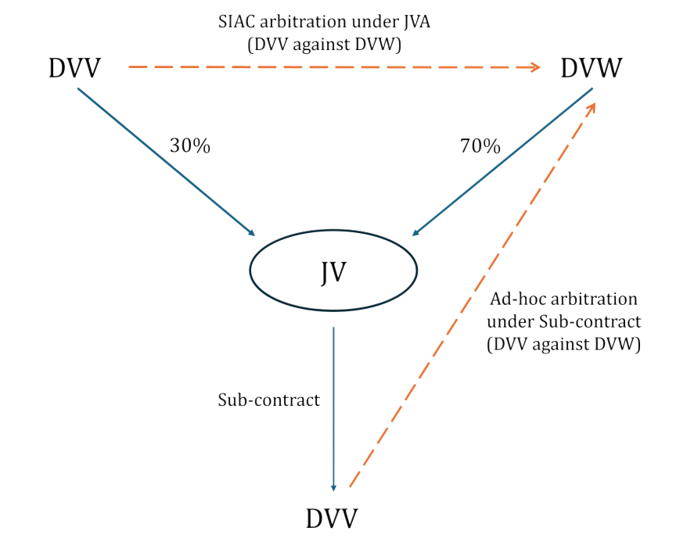
The parties entered into a joint venture agreement (JVA) forming an unincorporated joint venture (JV) to carry out a construction project. DVV (the Applicant) held 30% and DVW (the Respondent) held 70% of the participation shares. The JV sub-contracted some work to DVV. Disputes arose between the parties under both agreements.
DVV commenced two separate arbitrations against DVW – a SIAC arbitration under the JVA (JVA Arbitration) and an ad-hoc arbitration under the sub-contract (Sub-Contract Arbitration). DVW was the only entity able to be sued under the sub-contract, since DVV could not sue itself and an unincorporated JV is not capable of being sued.[2]
The Arbitration Proceedings
The Sub-Contract Arbitration transpired as a conventional construction dispute, with the sole arbitrator determining inter alia issues of delay and works performed. One counterclaim by DVW was for contribution and indemnity of 30% from DVV for any sums awarded, on the basis that liability between the parties was “several and not joint” under the JVA.[3] The Tribunal in the JVA Arbitration reserved their decision on this, until after award in the Sub-Contract Arbitration.
The sole arbitrator handed down a Partial Final Award, determining valuation but making no order for payment and reserved jurisdiction to make a final award, consequent on the apportionment issue being decided under the JVA Arbitration. This was “the first time he had encountered such a situation in his experience.”[4]
Importantly, the parties disagreed as to the approach the sole arbitrator should adopt. DVV suggested that the sole arbitrator was required to make an order for payment, whatsoever form this might take. DVW suggested any order for payment should await the JVA Tribunal’s determination of apportionment.
The sole arbitrator identified four methods which he could adopt. The first two – discount the amounts awarded by 30% or award full amounts with a contribution or indemnity – were rejected as determining an issue under the JVA which was outside of the sole arbitrator’s jurisdiction; in the challenge to the award, the parties agreed that this would have been outside the sole arbitrator’s jurisdiction.[5] The third and fourth options did not make any decision on apportionment. One option was to order the amounts be paid in full, and leave apportionment of the award to the JVA Arbitration (DVV’s preferred option); the final option was to determine quantum, but await the JVA Tribunal’s decision on apportionment before an order for payment (DVW’s preferred option).[6]
In deciding to adopt the fourth option, the sole arbitrator noted that the third option may still attract jurisdictional challenge, and that reserving the final award until apportionment had been decided was the most desirable approach, and the approach contemplated in the JVA Arbitration.[7]
The Singapore High Court’s Thinking
DVV challenged the Partial Final Award on the basis of excess of jurisdiction under section 48(1)(a)(iv) and / or breach of the agreed arbitral procedure under section 48(1)(a)(v) of the Arbitration Act 2001 for the reason that the sole arbitrator had “abdicated and / or delegated his duty to decide”.[8] Gill J dismissed the challenge on both grounds.
The jurisdictional challenge failed for two primary reasons. First, excess of jurisdiction can only be raised when an arbitrator “decided something outside its mandate… It does not extend to the converse case, where a tribunal is said to have failed to deal with a matter”.[9] The sole arbitrator’s deferral to the JVA Tribunal on the issue of apportionment cannot be described as ultra petita, but rather must be viewed as failing to make a decision, which gives rise to an infra petita challenge under natural justice – the claim was brought under the wrong ground. Second, it is not clear what decision the arbitrator improperly delegated. Both parties accepted that apportionment was within the jurisdiction of the JVA Arbitration only – “one cannot delegate a power one does not possess”.[10] The sole arbitrator did not delegate his decision to make an order for payment, but rather reserved jurisdiction until the apportionment issue was resolved by the JVA Tribunal.
The challenge for breach of agreed arbitral procedure also failed. Such challenge “cannot be invoked to impugn the substance of an award, or the outcome of the arbitral procedure the tribunal adopted”.[11] The form of the award – in this case the absence of an immediate order for payment – was held to be a substantive matter. In choosing the form, the sole arbitrator had to evaluate a series of substantive questions about jurisdiction and liability. Gill J differentiated this from a standard procedural decision to bifurcate quantum and liability. The reason for reserving jurisdiction on the order for payment was due to the substantive question of apportionment which was outside the sole arbitrator’s jurisdiction.[12] Furthermore, considering the parties were in dispute as to the form of award, on the facts there was no agreed procedure.[13]
Our Thoughts
The Court’s decision on the proper application of excess jurisdiction is important – the focus is on what the tribunal has decided outside of its mandate rather than what it did not decide. This is a nuanced point and Gill J’s judgement is helpful. Equally, the reminder that breach of natural justice does not relate to substantive issues will be welcome. It is tempting to think that these are ‘textbook’ points or reminders, but judicial comments tend to be better received. Joinder provisions are a good theoretical option to avoid competing awards and delay, but we rarely see such provisions in international construction.
[1] [2026] SGHC 164 (“DVV”).
[2] Ibid, at [8].
[3] DVV (n. 1), at [11].
[4] Ibid, at [14].
[5] DVV (n. 1), at [55].
[6] Ibid, at [19] to [20].
[7] DVV (n. 1), at [21].
[8] Ibid, at [26].
[9] DVV (n. 1), at [50].
[10] Ibid, at [56].
[11] DVV (n. 1), at [63].
[12] Ibid, at [69].
[13] DVV (n. 1), at [71].

